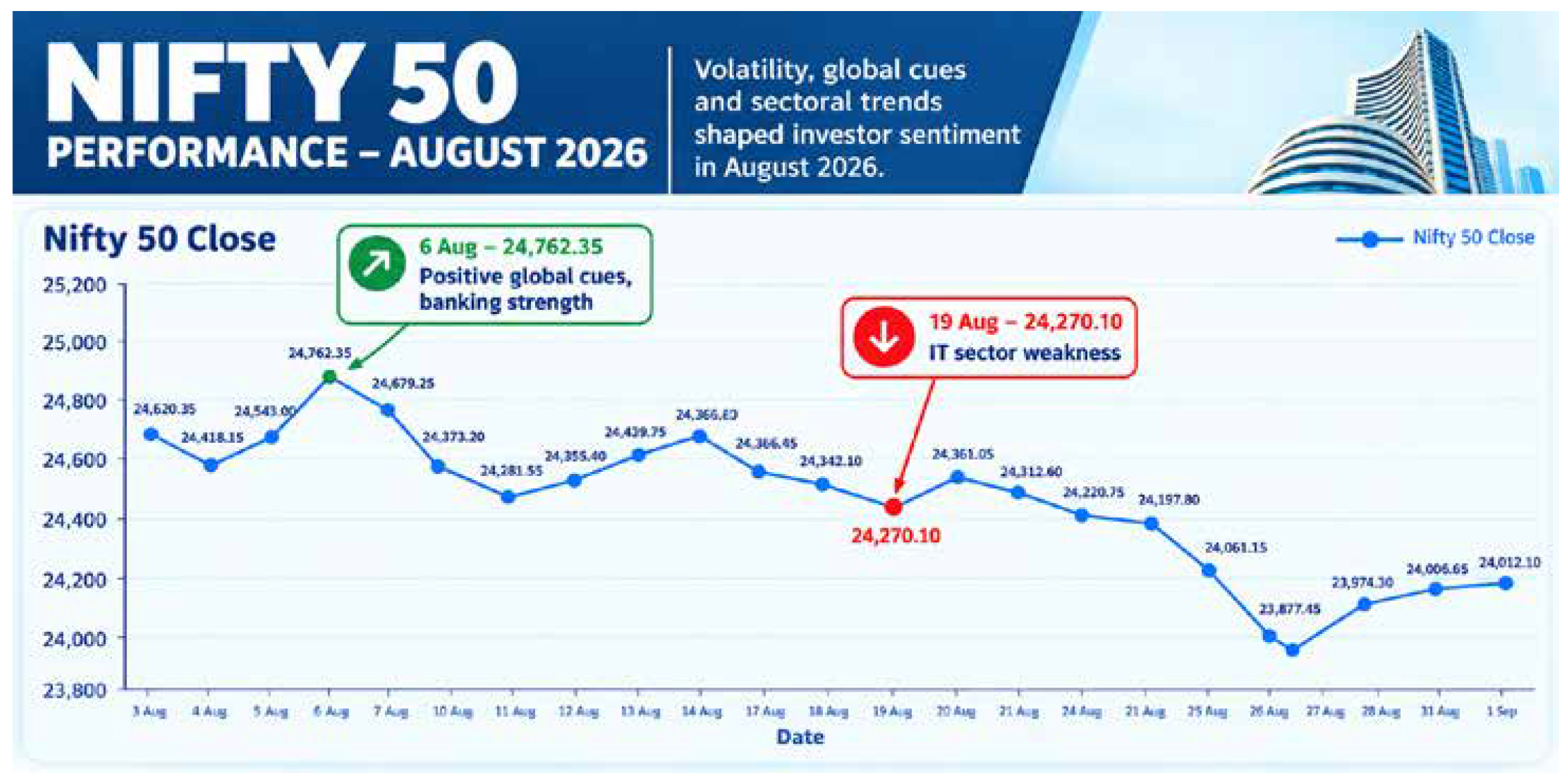
August 2026 proved to be a challenging month for India’s benchmark equity indices, with both the Nifty 50 and the BSE Sensex ending in negative territory and snapping their two-month winning streak from June and July. The Nifty 50 closed the month at 24,080.40, declining approximately 1.24% from its July-end level, while the BSE Sensex ended at 76,957.27, down around 1.46%. Although the headline indices registered losses, the broader market displayed considerably more resilience, with mid- and small-cap stocks continuing to attract investor interest. This divergence highlighted that August was less a broad-based market correction and more a period of pressure on large-cap stocks amid a challenging global macroeconomic environment.
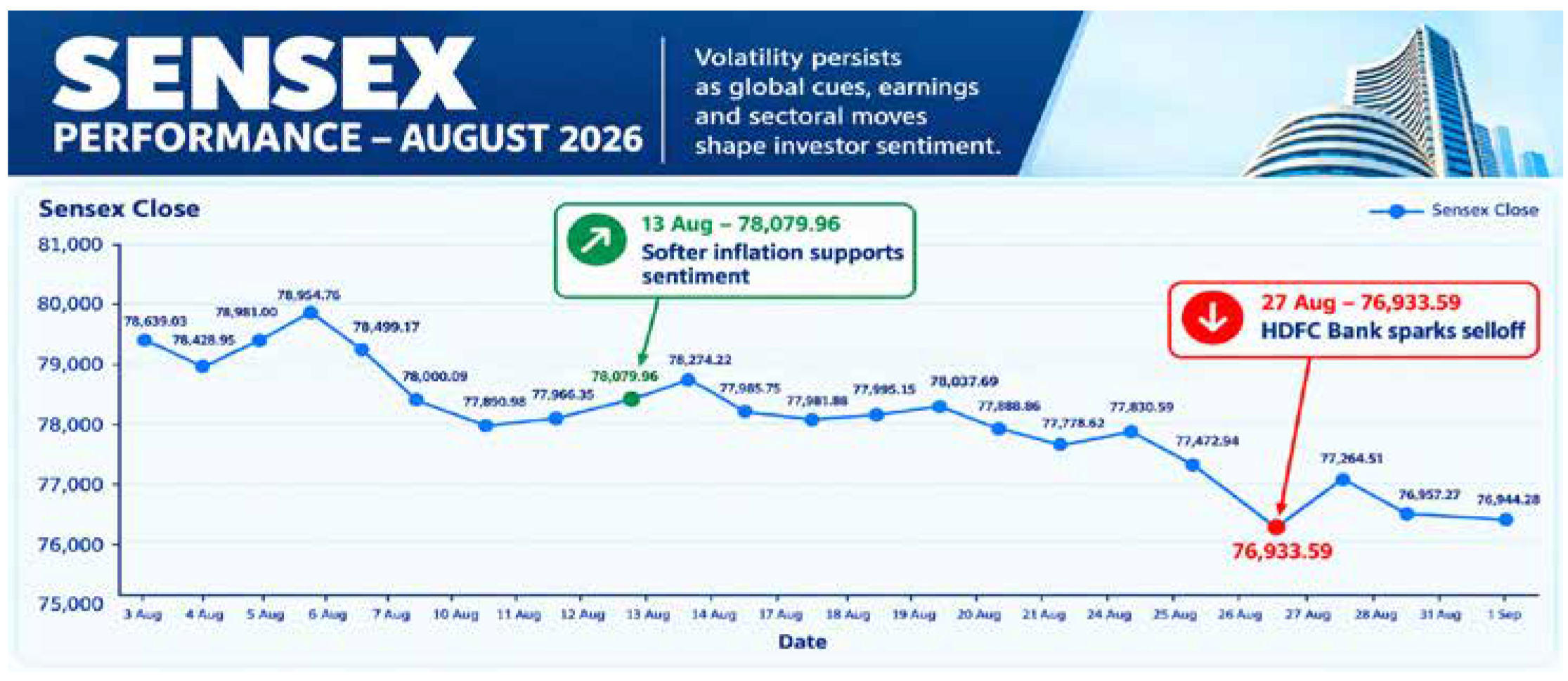
The month began on a relatively stable note, with the benchmark indices remaining firm during the first week and even registering modest gains. However, sentiment deteriorated as the month progressed. The indices experienced a prolonged period of weakness, including a seven-session losing streak in mid-August, before staging a brief recovery. The recovery, however, proved short-lived as renewed global risk-off sentiment pushed the market lower toward the end of the month. The combination of geopolitical concerns, higher crude oil prices, uncertainty over global interest rates and currency pressures ultimately weighed on investor sentiment.
One of the most significant factors influencing Indian
equities during August was the sharp rise in crude oil
prices. Brent crude moved towards $93–94 per barrel
by late August amid renewed tensions in the Middle
East and uncertainty surrounding the Strait of Hormuz.
Higher crude prices increase the country’s import bill
and can widen current-account pressures, while
simultaneously putting pressure on the Indian rupee.
Rising oil prices can also contribute to higher domestic
inflation and put pressure on corporate margins,
particularly for companies and industries that are
heavily dependent on energy and transportation costs.
With headline CPI inflation already at 4.5% in July, the
increase in crude prices added another layer of concern
for investors. Consequently, oil emerged as one of the
biggest factors weighing on market sentiment
throughout August.
Global interest-rate expectations were another
important source of volatility. Towards the latter part of
August, hawkish signals from the US Federal Reserve,
coupled with rising global bond yields, triggered
renewed risk-off sentiment across emerging markets.
Higher US yields make dollar-denominated assets
relatively more attractive and can reduce the appeal of
emerging-market equities such as India. A stronger
dollar can also put additional pressure on
emerging-market currencies, including the rupee. At the
same time, higher global yields increase the discount
rate applied to future corporate earnings, which can
weigh particularly heavily on high-growth and
interest-rate-sensitive sectors. These concerns
contributed to the selling pressure on large-cap Indian
equities during the latter part of the month.
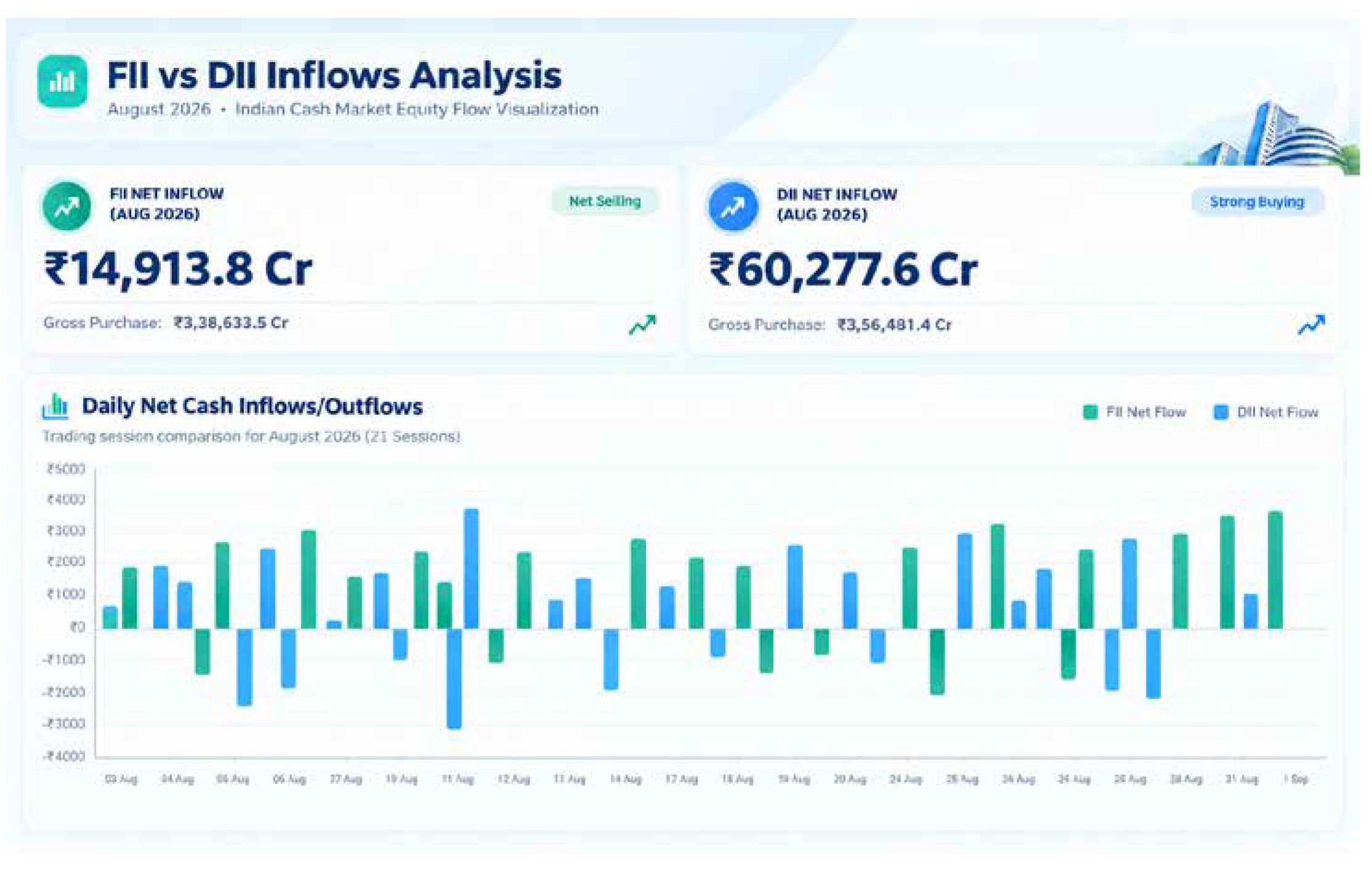
Foreign institutional investor flows also played a key role
in market direction. At the beginning of August, foreign
investors turned net buyers for several sessions, helping
the domestic market remain relatively resilient despite
concerns surrounding crude oil. However, as oil prices
climbed and global yields increased, foreign flows
became more cautious and turned negative during parts
of the month. This contributed to the weakness seen
towards month-end. Currency movements added to the
pressure. The rupee weakened from around
₹95.17–95.20 per US dollar early in August to
approximately ₹95.70 by late August, with the Reserve
Bank of India intervening to contain excessive volatility
around the ₹96 per dollar level. Foreign-flow uncertainty
and rupee depreciation remained key concerns for
investors.
Domestic inflation also remained an important
consideration. July CPI inflation of 4.5% kept inflationary
pressures on the radar, particularly amid rising crude oil
prices. If higher oil prices persist, the potential for
renewed inflation could limit the room available for
further monetary easing. For equity markets, higher
inflation and reduced expectations of rate cuts can act
as a valuation headwind, especially for growth-oriented
and rate-sensitive segments. Thus, even though
domestic economic fundamentals remained relatively
supportive, the market had to balance those positives
against the possibility of a less accommodative
monetary environment.
Corporate earnings provided some support during the
month. The Q1 FY27 earnings season was broadly
encouraging, with several companies reporting results
ahead of market expectations. This helped sustain
selective buying and provided support to stocks with
strong earnings visibility. Importantly, the earnings
environment prevented the market correction from
becoming more widespread. Instead, the market
became increasingly stock-specific, with investors
rewarding companies that delivered strong results while
remaining cautious towards businesses exposed to
macroeconomic and global risks. This also helped mid and small-cap stocks remain relatively resilient even as
the major benchmark indices came under pressure.
The divergence between large-cap and broader-market
performance was one of the defining characteristics of
August. While the Nifty 50 and Sensex declined, the
Nifty Midcap 100 gained approximately 2.1%, and the
Nifty Smallcap 100 rose around 3.1%. This suggests
that the month was not characterised by indiscriminate
selling across the equity market. Instead, investors
continued to identify opportunities in mid- and
small-cap companies, particularly those supported by
strong earnings and domestic demand. The relative
strength of these segments indicates that domestic
liquidity and investor appetite for selected growth
opportunities remained intact despite pressure on the
headline indices.
Market structure also contributed to volatility during
August. India introduced the new Closing Auction
Session mechanism on August 3, changing the process
through which official closing prices are determined.
While this structural change was not the primary reason
for the monthly decline, it contributed to increased
intraday volatility, particularly around the final minutes of
trading, expiry sessions and index rebalancing events.
The market also witnessed additional stock-specific
volatility due to the MSCI index rebalancing at the end of
August. Changes in index weightings resulted in
significant buying and selling activity in individual stocks
and amplified movements in certain large-cap names.
The performance of heavyweight stocks was another
factor behind the weakness in the headline indices.
HDFC Bank, one of the largest constituents of both the
Sensex and Nifty, came under pressure following
uncertainty surrounding its future leadership after the
announcement that its CEO would not seek
reappointment. Given the significant weight of the bank
in the benchmark indices, weakness in the stock had an
outsized impact on index performance. Reliance
Industries also came under pressure following changes
to its MSCI weighting, adding to the weakness in
large-cap benchmarks.
Overall, August 2026 has given contrasting signals for
Indian equities. The Nifty 50 declined approximately
1.2%, while the Sensex fell around 1.4–1.5%. However,
the resilience of mid- and small-cap stocks, supportive
corporate earnings and continued domestic liquidity
demonstrated that investor confidence had not
disappeared. The principal challenge came from the
external environment, particularly crude oil prices, Middle
East tensions, US interest-rate expectations, global bond
yields and currency movements.
Indian debt markets went through a genuinely turbulent
August 2026, even though the month began on a fairly
stable footing. The Reserve Bank of India's Monetary
Policy Committee, meeting from August 3 to 5, kept the
repo rate unchanged at 5.25% for a fourth straight review,
retained its "neutral" stance in a unanimous 6-0 vote, and
actually raised its FY27 GDP growth forecast to 6.7%
while trimming its inflation projection — a broadly
reassuring start that gave short- and medium-duration
bonds some initial support. But sentiment deteriorated
steadily through the second half of the month, and by
August 31 the market looked very different from how it
had looked on August 5.
The benchmark 10-year G-Sec yield was the clearest
signal of this shift. Having traded in the
high-6.7%-to-6.8% range for much of August, it climbed
through the final week to touch around 6.95% by
month-end — a twelve-week high and one of the sharpest
monthly moves of the fiscal year. Three forces combined
to drive this: Brent crude pushing back up toward the
low-$90s a barrel on Middle East tensions and worries
about the Strait of Hormuz, which raised India's
import-bill and inflation concerns; hawkish commentary
from US Federal Reserve Chair Kevin Warsh around the
Jackson Hole period, which lifted US Treasury yields (the
10-year US yield hovered near 4.6–4.7%) and firmed up
expectations of a September Fed move; and a domestic
mood that had turned more cautious even without an
actual RBI rate hike, as commentary around the August
MPC minutes and remarks from senior RBI officials on
food and fuel price risks were read by markets as leaving
less room for further easing. It's worth being precise
here: the RBI did not signal an imminent hike in its formal
August decision — it held rates and kept a neutral stance
— but the tone of subsequent commentary was enough
to shift trader expectations toward "when," not "if," a
tightening bias might eventually emerge.
The move up the curve was not uniform. Shorter-tenor
instruments — treasury bills, certificates of deposit,
commercial paper — stayed comparatively insulated
because they track the RBI's policy rate and liquidity
conditions more than long-run inflation expectations,
and the repo rate itself never moved. This left a curve that
flattened or bear-steepened depending on the segment:
long-dated G-Secs bore the brunt of the sell-off even as
very short paper held up reasonably well. Adding to the
pressure at the front end, the RBI's special FCNR(B)
window for dollar deposits — which had drawn a strong
response — was closed early, on August 31 rather than
its original September 30 deadline, removing a source of
dollar inflows that had been finding its way into
short-term Indian debt and tapering off one of the props
that had kept front-end yields lower earlier in the year.
Corporate bonds moved in step with the sovereign curve,
with yields rising most at the short end, though quality
made a real difference: AAA-rated paper from financial
institutions, PSUs and large corporates continued to see
solid demand, since the deterioration was almost entirely
an interest-rate story rather than a credit story. Investors
stayed selective, favoring AAA/AA names and
shorter-to-intermediate maturities rather than reaching
for yield further down the credit spectrum. That said, the
rise in benchmark yields visibly cooled primary issuance
— companies raised markedly less through private
placements in August than in July, as higher borrowing
costs discouraged fresh deals, and bankers were
doubtful of a quick rebound in September given how
sharply yields had moved.
State Development Loans tracked the same dynamic as
G-Secs, since they're priced off the sovereign curve:
existing holders faced mark-to-market losses, but the
higher yields also meant more attractive entry points for
new buyers, with SDLs still drawing interest from
investors seeking spread pickup over comparable central
government paper. On the flows side, debt mutual funds
carried into August a pattern of weaker allocations to
duration that had already been building over April–July,
with short-duration, low-duration and banking & PSU
funds — offering roughly 7–8% yields with high credit
quality — remaining the preferred pockets, while
duration-oriented funds saw reduced demand as
managers like those at Bandhan AMC actively trimmed
portfolio duration ahead of anticipated rate risk.
Foreign investors added further pressure. With India-US
10-year spreads compressed toward multi-decade lows,
and the rupee under strain from both oil and a firmer
dollar, Indian bonds looked comparatively less attractive
once currency and hedging costs were factored in — a
dynamic reinforced by the same hawkish Fed repricing
that pushed US yields higher.
Taken together, August 2026 was essentially a "yields up,
duration down" month: an unchanged repo rate and
neutral RBI stance provided a floor, but oil-driven inflation
risk, a hawkish turn in global rates, fading FCNR-related
liquidity support, and heavy long-end supply pushed the
10-year G-Sec to a twelve-week high near 6.95%.
Short-duration and high-quality credit held up
comparatively well, leaving long-dated government and
corporate bonds as the clear underperformers — though
the resulting higher yields.
Precious metals delivered a strong performance in
August 2026, with both gold and silver witnessing sharp
rallies and reaching fresh record levels before
experiencing some profit-taking towards the end of the
month. Domestic 24-carat gold started August at around
₹1,43,680 per 10 grams on August 3 and gained steadily
during the month, crossing ₹1,48,000–₹1,49,000 in the
first week before accelerating further. By August 24, gold
reached a fresh record of around ₹1,64,730 per 10 grams,
gaining nearly 15% from the beginning of the month.
Internationally, Comex gold also touched a new high of
around US$4,737 per ounce, highlighting the strength of
the global bullion rally. The sharp rise was supported by a
combination of expectations for a more accommodative
US monetary-policy outlook, lower US yields, dollar
weakness, geopolitical uncertainty and continued
institutional demand. However, the pace of appreciation
left gold vulnerable to profit-booking. By August 31,
domestic gold had corrected to approximately ₹1,55,430
per 10 grams, nearly 5% below its August peak, although
it remained substantially higher than its level at the
beginning of the month.
Silver followed a similar upward trajectory but
demonstrated greater resilience during the late-month
correction. Domestic silver started August at around
₹2,184 per 10 grams, equivalent to approximately ₹218
per gram, and climbed to about ₹2,479 per 10 grams by
August 24. Although it eased towards month-end, silver
declined only modestly to approximately ₹2,423 per 10
grams, or ₹2,42,320 per kilogram, on August 31. This still
represented a monthly gain of more than 11% based on the
domestic prices cited. Internationally, Comex silver traded
around US$67 per ounce towards the end of August. Silver's
relative outperformance during the correction reflected its
additional support from industrial demand and tight
physical inventories. Demand from solar photovoltaic
applications, electric vehicles, electronics and data-centre
infrastructure remained an important structural driver, while
investment demand provided further momentum.
Several factors contributed to the broad-based rally in
precious metals. First, expectations of a softer US Federal
Reserve policy stance and periods of weakness in the US
dollar reduced the opportunity cost of holding non-yielding
assets such as gold and silver. Expectations of lower real
interest rates, reinforced by softer US economic and
employment indicators, encouraged investors to increase
exposure to bullion. US Treasury yields also declined at
various points during the month, providing an additional
tailwind. Second, investment flows improved materially.
After a period of weakness and outflows, global gold
exchange-traded products witnessed renewed buying, with
significant inflows during early and mid-August, signalling a
recovery in institutional investor sentiment. Indian gold ETFs
also continued to attract investor interest, supporting
domestic investment demand.
Central-bank purchases remained another important
structural pillar of the precious-metals market. Countries
including China, Poland, Uzbekistan and Kazakhstan
continued to accumulate gold, reinforcing expectations that
official-sector demand would remain strong. Such
purchases provide a relatively stable source of demand and
have helped strengthen the longer-term investment case for
gold despite periodic corrections. Geopolitical tensions also
supported safe-haven demand. Renewed concerns
surrounding the Middle East, including tensions affecting
regional shipping and energy supplies, encouraged
investors to seek defensive assets. Rising crude-oil prices
added to market uncertainty, although the impact of higher
energy prices on bullion was mixed because persistent
inflation could potentially delay monetary easing.
Silver benefited from the monetary and safe-haven factors
supporting gold while also adding momentum from its
industrial fundamentals. Tight inventories, robust industrial
consumption and expectations of continued demand from
renewable energy, electric vehicles, electronics and
technology infrastructure helped silver outperform during
the rally.
Overall, August 2026 was a particularly strong month for
bullion, driven by a combination of lower real yields,
dollar movements, geopolitical uncertainty, central-bank
accumulation and renewed investment flows. Silver
additionally benefited from structural industrial demand
and supply tightness, enabling it to demonstrate greater
resilience during the late-month correction.
The Indian rupee had a choppy but largely range-bound
trading pattern in August 2026, remaining under pressure
for most of the month but ending only marginally weaker
against the US dollar. USD/INR opened the month at
around ₹95.40 and traded within a relatively narrow but
volatile range. The rupee strengthened to approximately
₹94.84 on August 5, supported by a temporary decline in
crude-oil prices following the Reserve Bank of India's
policy decision, but subsequently weakened as oil prices
and global risk concerns resurfaced. The currency
touched around ₹96.00 on August 24 before recovering
towards the end of the month. Overall, USD/INR closed
August near ₹95.17–₹95.60, depending on the market
reference used, implying only a marginal monthly
depreciation of roughly 0.1–0.5%. Despite this limited
monthly movement, the rupee remained close to
historically weak levels and had depreciated significantly
over the preceding year.
The principal pressure on the rupee came from
fluctuations in crude-oil prices amid continuing
geopolitical tensions in the Middle East. Brent crude
remained elevated for much of August as concerns over
the Strait of Hormuz and uncertainty surrounding the
US-Iran situation periodically intensified. Oil prices
moved towards the high-$80s and, at times, closer to $90
per barrel before easing as geopolitical concerns
moderated. Given India's dependence on imported crude,
higher oil prices directly increase the country's import bill
and demand for US dollars, placing downward pressure
on the rupee. Conversely, temporary declines in crude
prices provided short-lived relief to the currency.
Sustained dollar demand from importers also weighed
on the rupee, as Indian companies needed foreign
currency to settle import bills and meet their external
obligations. Maturing positions in the offshore
non-deliverable forward (NDF) market further
contributed to intermittent dollar demand.
Global monetary and financial-market conditions added
to the pressure. The US dollar remained relatively firm
during parts of August as elevated US Treasury yields
and uncertainty surrounding the Federal Reserve's future
policy direction encouraged demand for the dollar. Higher
US yields reduce the relative attractiveness of
emerging-market assets and can trigger capital outflows,
thereby weighing on currencies such as the rupee. Periodic
risk-off sentiment in global markets, coupled with selling by
foreign portfolio investors in Indian equities, also generated
additional demand for dollars.
A key factor preventing a sharper depreciation was active
intervention by the Reserve Bank of India. The RBI reportedly
continued to manage currency volatility through spot and
forward-market operations, selling dollars when pressure on
the rupee intensified. This intervention helped contain
moves beyond the ₹95.5–₹96 levels and reinforced the
perception that the central bank was willing to prevent
excessive volatility rather than target a specific
exchange-rate level. Strong foreign-exchange reserves
provided the RBI with sufficient capacity to smooth the
market and absorb temporary demand for dollars.
Foreign-currency inflows through the RBI's special FCNR(B)
deposit-related measures also provided support during the
month. These inflows strengthened the country's external
liquidity position and increased the RBI's ability to intervene
in the foreign-exchange market. However, support from
these flows began to diminish towards month-end as the
special FCNR(B) window was closed earlier than originally
scheduled. This reduced one of the temporary cushions
supporting the rupee.
Overall, August 2026 was characterised more by managed
stability than a clear directional move. Elevated crude prices,
geopolitical uncertainty, firm US yields and sustained dollar
demand created persistent depreciation pressure, while RBI
intervention, strong foreign-exchange reserves and
foreign-currency inflows helped absorb much of the
pressure. As a result, the rupee remained broadly
range-bound and ended the month only marginally weaker,
despite trading close to its historical lows. The August
experience highlighted the RBI's continued role in smoothing
currency volatility and demonstrated how policy intervention
and external liquidity buffers can temporarily offset
challenging global and domestic fundamentals.
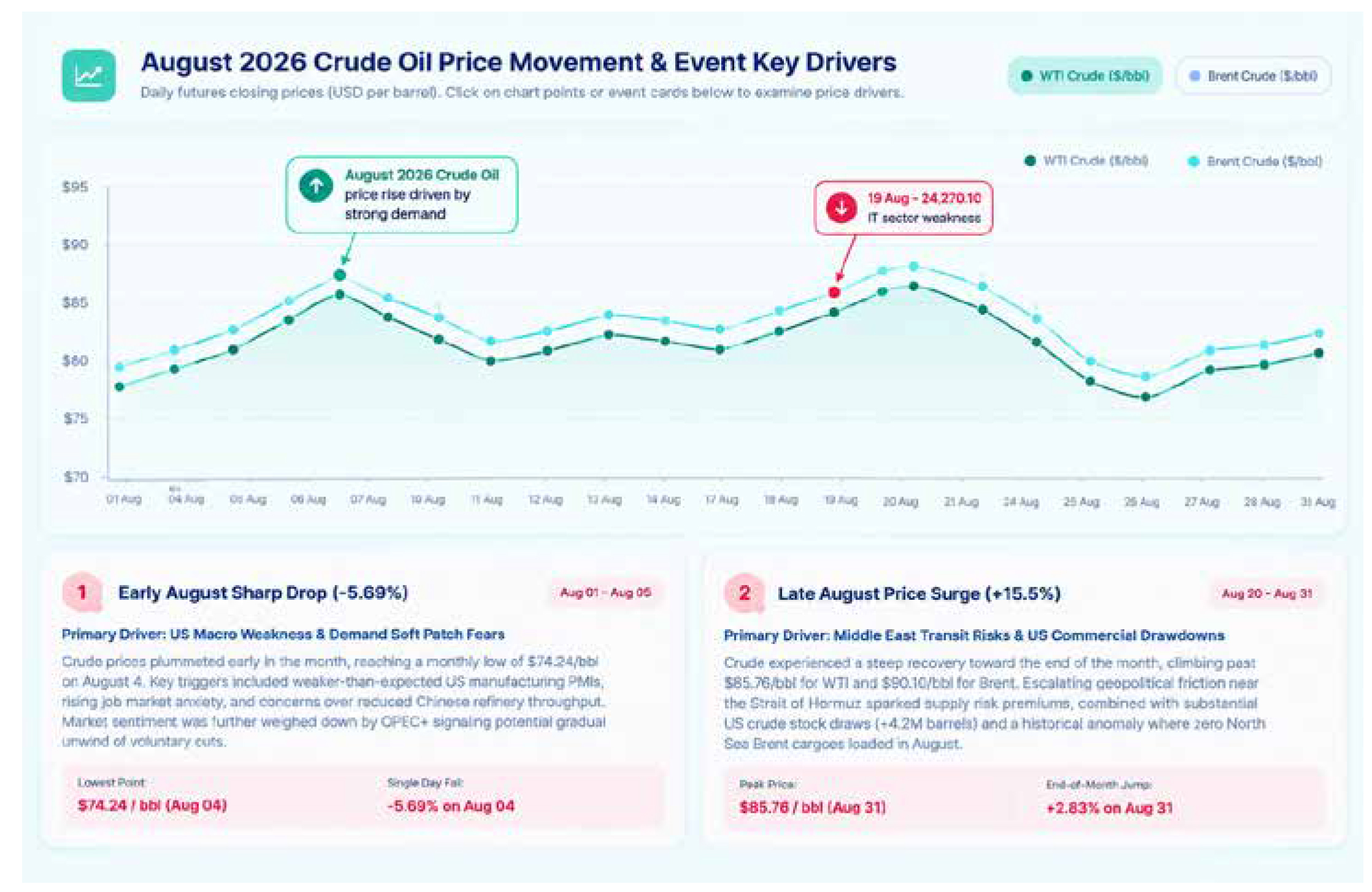
Crude oil prices experienced a sharp, volatile rally in
August 2026, with geopolitical developments
surrounding the US-Iran conflict and the Strait of
Hormuz emerging as the dominant drivers. After
easing from the extreme levels seen earlier in the
year, oil prices regained momentum as hopes of a
lasting diplomatic resolution weakened and
concerns increased over the security of one of the
world's most important oil-transit routes. Brent
crude opened August in the mid-$80s per barrel and
moved steadily higher through the month, reaching
the low-to-mid $90s by the final weeks. WTI crude
followed a similar trajectory, rising from the
low-$80s to the mid-to-high $80s. Overall, Brent
posted a notable gain for the month, though prices
stayed highly reactive to shifting geopolitical
developments and news around shipping in the
Persian Gulf.
The Strait of Hormuz remained the major factor
behind the rally. A significant share of global oil
shipments normally passes through the narrow
waterway, making
any disruption potentially consequential for global
supply. During the month, tanker traffic remained
affected by the ongoing confrontation between the US
and Iran, while uncertainty over the security and
accessibility of the strait encouraged traders to price a
substantial geopolitical risk premium into crude.
Concerns intensified following reports of attacks and
military actions involving shipping and energy
infrastructure in the region. The possibility of a
prolonged disruption to oil exports raised fears that
available supplies could tighten rapidly, particularly
because alternative routes cannot fully replace the
volumes normally transported through Hormuz.
A second major influence was the repeated breakdown
of diplomatic efforts. Oil prices displayed a clear
pattern of reacting to every shift in US-Iran negotiations.
Whenever markets perceived that an agreement could
restore normal tanker traffic, crude prices temporarily
declined. Conversely, stalled negotiations, tougher
rhetoric and renewed military threats triggered fresh
buying in oil futures. This led to considerable price
swings within the month, with Brent repeatedly
oscillating between the high-$80s and low-$90s
before settling into a firmer upward trend in the latter half
of August. Ongoing uncertainty kept traders from fully
discounting the supply risk, even as physical demand
expectations stayed relatively muted.
Supply concerns were compounded by low global
inventories and disruptions to refining output. Reduced
flows linked to the Hormuz situation tightened physical
markets further, while refinery outages elsewhere added
strain to refined-product supplies. Diesel and other
middle-distillate markets stayed particularly tight, partly
due to disruptions in Russian refining capacity and
logistical bottlenecks in the Middle East. Healthy refining
margins pushed refiners to compete harder for available
crude, lending further support to benchmark prices.
The demand outlook, however, remained a moderating
factor. Concerns about global economic growth and a
relatively weak recovery in China led some agencies and
market participants to revise oil-demand expectations
lower. This prevented prices from rising even more
sharply and created periodic corrections during the
month. Nevertheless, the market's focus remained firmly
on potential supply disruptions rather than demand
weakness. In other words, August's rally was driven
primarily by geopolitical risk and supply uncertainty
rather than a sudden improvement in underlying global
oil consumption.
Overall, August 2026 was characterised by a
geopolitics-led oil rally. Brent moved from the mid-$80s
towards the low-to-mid $90s, while WTI also recorded a
substantial gain. The combination of heightened US-Iran
tensions, uncertainty around the Strait of Hormuz,
disrupted tanker traffic, tighter inventories and
refined-product markets pushed prices higher. Although
softer global demand and occasional diplomatic
optimism triggered temporary pullbacks, the persistent
risk of supply disruption kept crude firmly supported. The
rise in oil prices also had important implications for
oil-importing economies such as India, contributing to
pressure on the rupee, inflation expectations and
domestic financial markets during the month.
August 2026 marked a significant period of regulatory tightening and structural reform for India’s insurance sector, with the Insurance Regulatory and Development Authority of India (IRDAI) taking a more stringent approach to cost discipline, intermediary governance, capital adequacy and customer protection. A key development was IRDAI’s decision to bar Edelweiss Life Insurance, Pramerica Life Insurance, Niva Bupa Health Insurance and ACKO General Insurance from opening new places of business for six months for breaching prescribed Expense of Management (EoM) limits in FY25. The action was notable because it moved beyond conventional monetary penalties and introduced direct restrictions on business expansion, signalling stronger regulatory enforcement. Alongside this, the new Insurance Intermediaries Amendment Regulations, 2026 brought major changes to the distribution framework, including perpetual registration for intermediaries subject to continuing compliance, mandatory tagging of every policy to the salesperson responsible for its sale, tighter governance and disclosure requirements, and a more structured penalty mechanism. These measures are expected to improve accountability, strengthen oversight and reduce mis-selling. IRDAI also streamlined regulations covering insurer registration, capital structures, share transfers and amalgamations, aligning the framework with the 100% foreign direct investment regime and making capital raising, ownership changes and M&A transactions easier. The increased flexibility is expected to encourage greater foreign participation and capital movement across the sector. Meanwhile, a Parliamentary Committee urged IRDAI to accelerate the proposed Risk-Based Capital (RBC) framework and called for board-approved solvency restoration plans for financially weaker public-sector general insurers, with government capital support to be considered only after internal corrective measures. In health insurance, an IRDAI advisory committee proposed customer-focused reforms aimed at simplifying policy language, strengthening point-of-sale underwriting, reducing claim disputes and enabling faster settlements through standardised treatment pricing and digital platforms such as NHCX. IRDAI also enhanced sector-level data reporting by requiring insurers to submit monthly information on premiums, claims and investment income for inclusion in the government's Index of Service Production, improving the timeliness and quality of insurance-sector statistics. At the same time, the implementation of 100% FDI through the automatic route continued to support foreign investment, strategic partnerships, acquisitions and ownership restructuring. Preparations for the launch of Bima Sugam, the proposed digital insurance marketplace, also progressed, with motor, health and term insurance products expected to be among the initial offerings. Overall, August reflected a clear shift towards stricter supervision combined with structural modernisation. The regulatory focus was increasingly centred on cost efficiency, risk-sensitive capital, transparent distribution and customer protection, while the liberalised capital regime created greater scope for foreign investment and consolidation. These developments are likely to accelerate competition, digitalisation and capital reallocation across India's life, health and general insurance segments while raising compliance expectations for insurers and intermediaries.