
Topic 1: EQUITY: LOSING STREAK
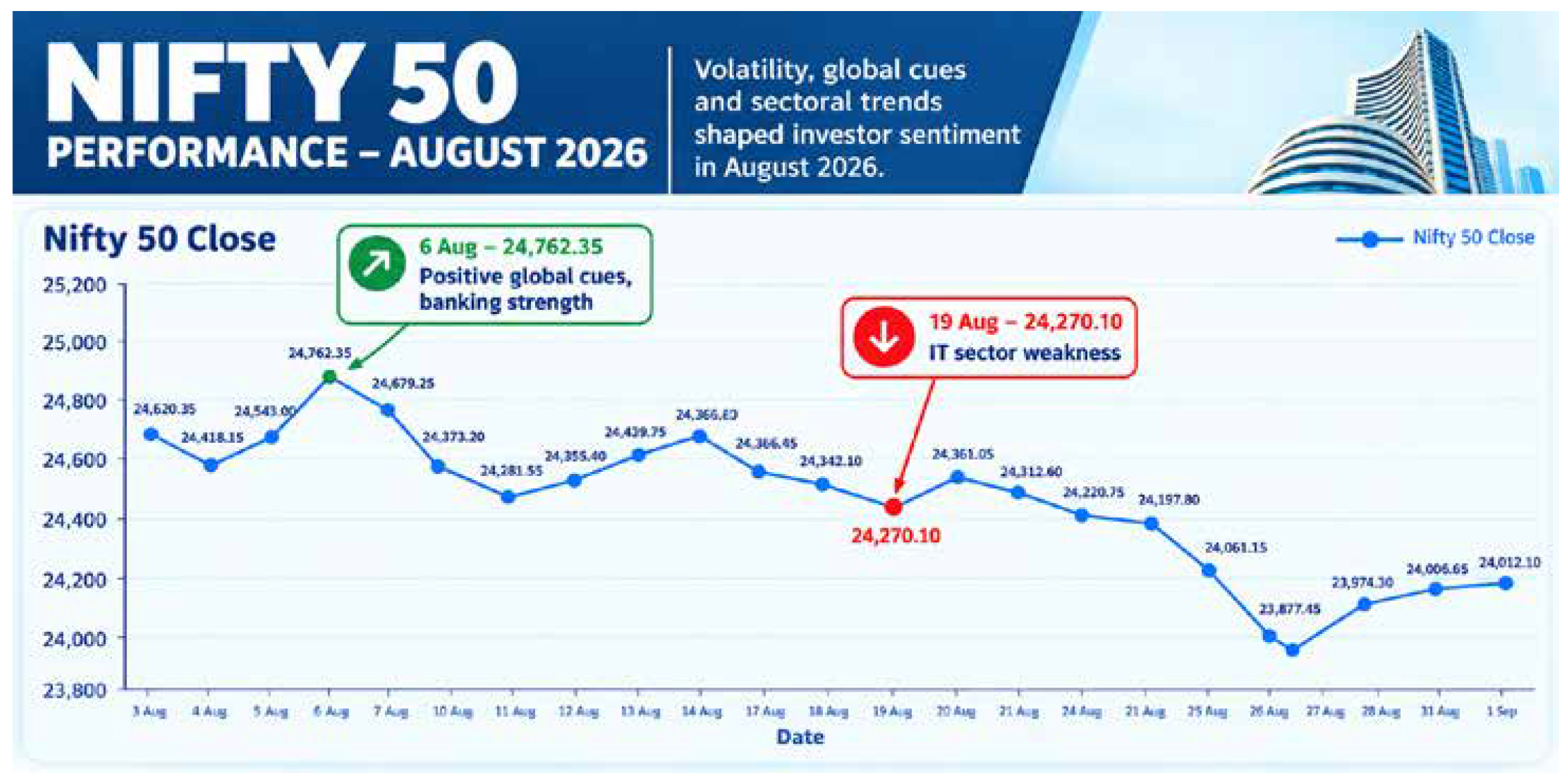
August 2026 proved to be a challenging month for India’s benchmark equity indices, with both the Nifty 50 and the BSE Sensex ending in negative territory and snapping their two-month winning streak from June and July. The Nifty 50 closed the month at 24,080.40, declining approximately 1.24% from its July-end level, while the BSE Sensex ended at 76,957.27, down around 1.46%. Although the headline indices registered losses, the broader market displayed considerably more resilience, with mid- and small-cap stocks continuing to attract investor interest. This divergence highlighted that August was less a broad-based market correction and more a period of pressure on large-cap stocks amid a challenging global macroeconomic environment.
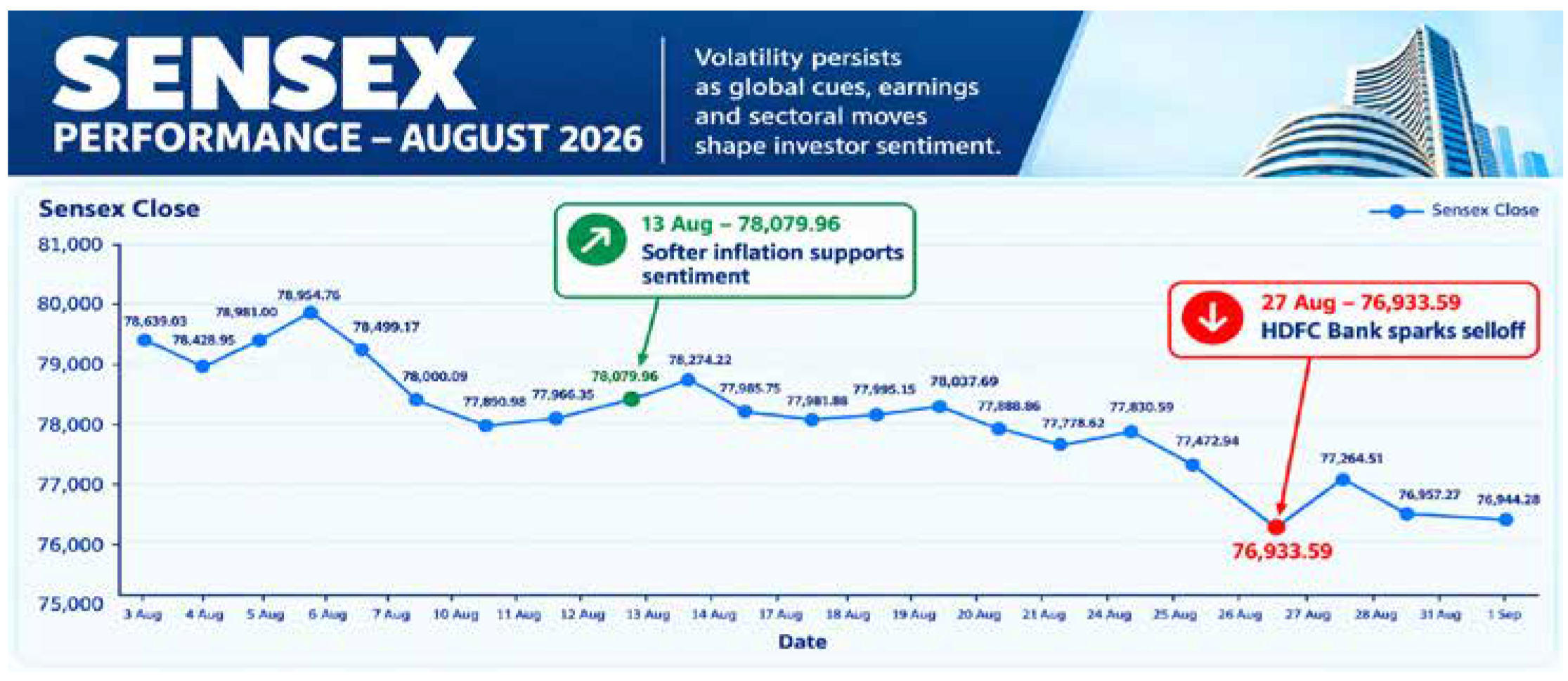
The month began on a relatively stable note, with the benchmark indices remaining firm during the first week and even registering modest gains. However, sentiment deteriorated as the month progressed. The indices experienced a prolonged period of weakness, including a seven-session losing streak in mid-August, before staging a brief recovery. The recovery, however, proved short-lived as renewed global risk-off sentiment pushed the market lower toward the end of the month. The combination of geopolitical concerns, higher crude oil prices, uncertainty over global interest rates and currency pressures ultimately weighed on investor sentiment.
One of the most significant factors influencing Indian
equities during August was the sharp rise in crude oil
prices. Brent crude moved towards $93–94 per barrel
by late August amid renewed tensions in the Middle
East and uncertainty surrounding the Strait of Hormuz.
Higher crude prices increase the country’s import bill
and can widen current-account pressures, while
simultaneously putting pressure on the Indian rupee.
Rising oil prices can also contribute to higher domestic
inflation and put pressure on corporate margins,
particularly for companies and industries that are
heavily dependent on energy and transportation costs.
With headline CPI inflation already at 4.5% in July, the
increase in crude prices added another layer of concern
for investors. Consequently, oil emerged as one of the
biggest factors weighing on market sentiment
throughout August.
Global interest-rate expectations were another
important source of volatility. Towards the latter part of
August, hawkish signals from the US Federal Reserve,
coupled with rising global bond yields, triggered
renewed risk-off sentiment across emerging markets.
Higher US yields make dollar-denominated assets
relatively more attractive and can reduce the appeal of
emerging-market equities such as India. A stronger
dollar can also put additional pressure on
emerging-market currencies, including the rupee. At the
same time, higher global yields increase the discount
rate applied to future corporate earnings, which can
weigh particularly heavily on high-growth and
interest-rate-sensitive sectors. These concerns
contributed to the selling pressure on large-cap Indian
equities during the latter part of the month.
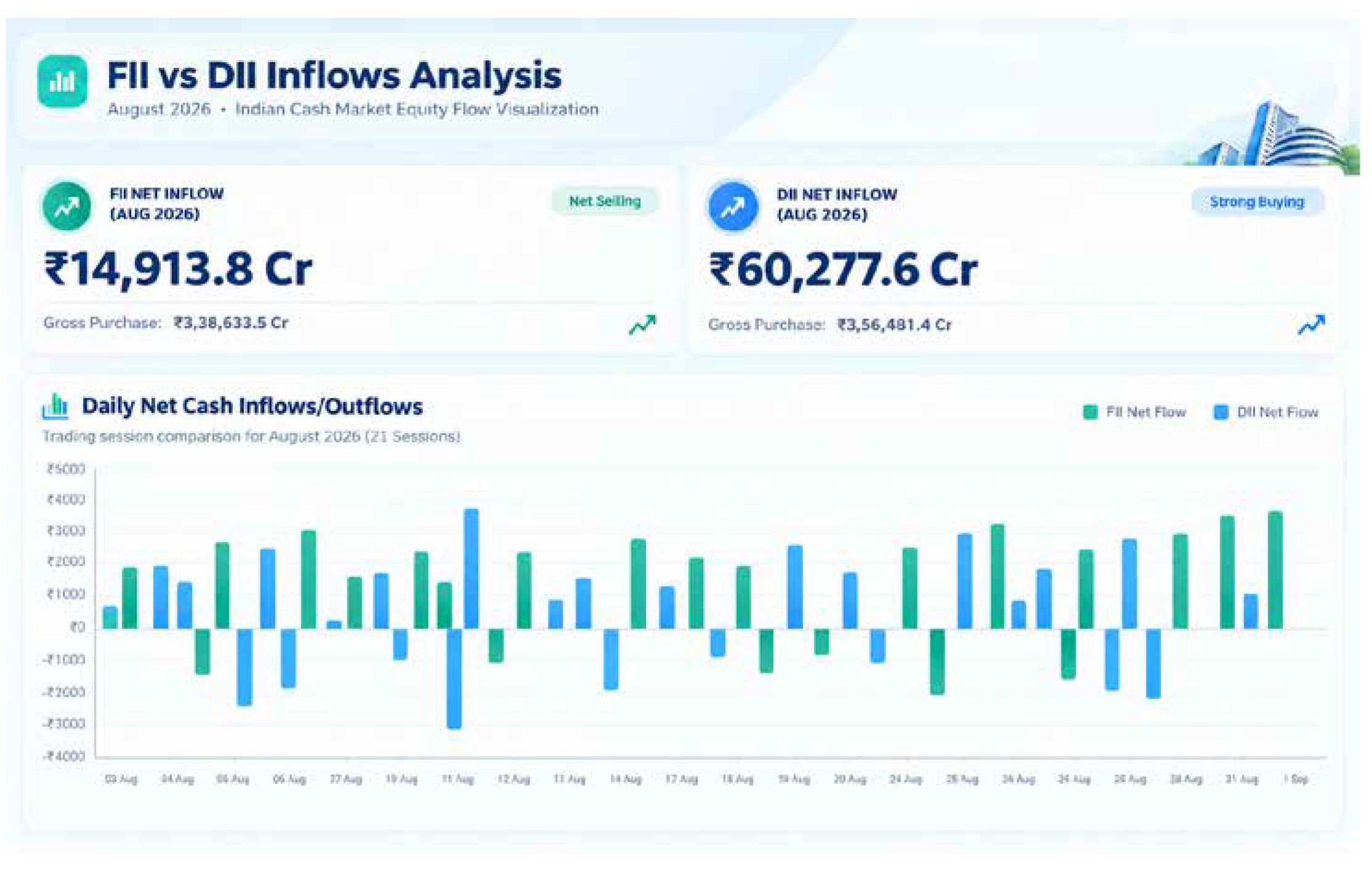
Foreign institutional investor flows also played a key role
in market direction. At the beginning of August, foreign
investors turned net buyers for several sessions, helping
the domestic market remain relatively resilient despite
concerns surrounding crude oil. However, as oil prices
climbed and global yields increased, foreign flows
became more cautious and turned negative during parts
of the month. This contributed to the weakness seen
towards month-end. Currency movements added to the
pressure. The rupee weakened from around
₹95.17–95.20 per US dollar early in August to
approximately ₹95.70 by late August, with the Reserve
Bank of India intervening to contain excessive volatility
around the ₹96 per dollar level. Foreign-flow uncertainty
and rupee depreciation remained key concerns for
investors.
Domestic inflation also remained an important
consideration. July CPI inflation of 4.5% kept inflationary
pressures on the radar, particularly amid rising crude oil
prices. If higher oil prices persist, the potential for
renewed inflation could limit the room available for
further monetary easing. For equity markets, higher
inflation and reduced expectations of rate cuts can act
as a valuation headwind, especially for growth-oriented
and rate-sensitive segments. Thus, even though
domestic economic fundamentals remained relatively
supportive, the market had to balance those positives
against the possibility of a less accommodative
monetary environment.
Corporate earnings provided some support during the
month. The Q1 FY27 earnings season was broadly
encouraging, with several companies reporting results
ahead of market expectations. This helped sustain
selective buying and provided support to stocks with
strong earnings visibility. Importantly, the earnings
environment prevented the market correction from
becoming more widespread. Instead, the market
became increasingly stock-specific, with investors
rewarding companies that delivered strong results while
remaining cautious towards businesses exposed to
macroeconomic and global risks. This also helped mid and small-cap stocks remain relatively resilient even as
the major benchmark indices came under pressure.
The divergence between large-cap and broader-market
performance was one of the defining characteristics of
August. While the Nifty 50 and Sensex declined, the
Nifty Midcap 100 gained approximately 2.1%, and the
Nifty Smallcap 100 rose around 3.1%. This suggests
that the month was not characterised by indiscriminate
selling across the equity market. Instead, investors
continued to identify opportunities in mid- and
small-cap companies, particularly those supported by
strong earnings and domestic demand. The relative
strength of these segments indicates that domestic
liquidity and investor appetite for selected growth
opportunities remained intact despite pressure on the
headline indices.
Market structure also contributed to volatility during
August. India introduced the new Closing Auction
Session mechanism on August 3, changing the process
through which official closing prices are determined.
While this structural change was not the primary reason
for the monthly decline, it contributed to increased
intraday volatility, particularly around the final minutes of
trading, expiry sessions and index rebalancing events.
The market also witnessed additional stock-specific
volatility due to the MSCI index rebalancing at the end of
August. Changes in index weightings resulted in
significant buying and selling activity in individual stocks
and amplified movements in certain large-cap names.
The performance of heavyweight stocks was another
factor behind the weakness in the headline indices.
HDFC Bank, one of the largest constituents of both the
Sensex and Nifty, came under pressure following
uncertainty surrounding its future leadership after the
announcement that its CEO would not seek
reappointment. Given the significant weight of the bank
in the benchmark indices, weakness in the stock had an
outsized impact on index performance. Reliance
Industries also came under pressure following changes
to its MSCI weighting, adding to the weakness in
large-cap benchmarks.
Overall, August 2026 has given contrasting signals for
Indian equities. The Nifty 50 declined approximately
1.2%, while the Sensex fell around 1.4–1.5%. However,
the resilience of mid- and small-cap stocks, supportive
corporate earnings and continued domestic liquidity
demonstrated that investor confidence had not
disappeared. The principal challenge came from the
external environment, particularly crude oil prices, Middle
East tensions, US interest-rate expectations, global bond
yields and currency movements.