
Topic 1: EQUITY: SWIVELLING EFFECT
February 2026 proved to be a month of sharp
cross-currents for Indian equity markets. After an early
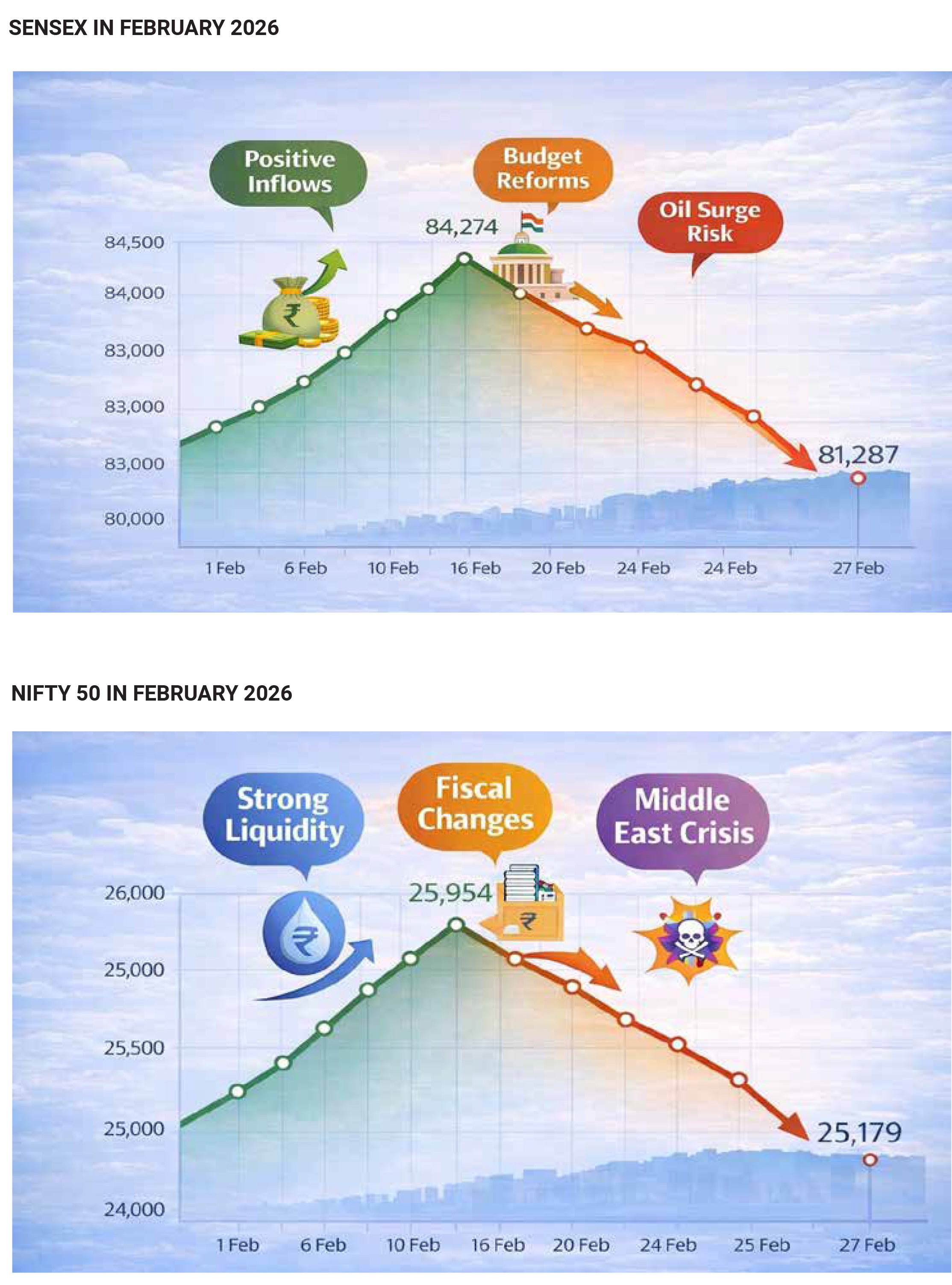
surge and multiple volatility spikes, the Sensex closed
the month with a modest decline of roughly 1–1.3%.
While the headline number suggests a mild pullback, the
internal churn beneath the surface was far more
dramatic, driven by sector-specific shocks, policy
surprises, shifting foreign flows, and global macro
tensions.
The benchmark began February on a strong footing,
buoyed by improved risk sentiment and renewed buying
interest. On 1 February, the index settled at 81,666.46
after a sharp jump, reflecting optimism around domestic
growth cues and foreign investor participation. However,
momentum soon tapered. Through mid-February, the
market traded in a tight consolidation band. By the week
ended 20 February, the Sensex had managed a marginal
weekly gain of just 0.23%, closing near 82,814.7. This
stability masked growing stress within certain
heavyweight sectors. By 27 February, the index had
drifted back toward the 81,300 zone, turning the month
marginally negative. On a calendar-year basis, the
Sensex was down about 2.8% by mid-month, reflecting
corrective pressure after the early January peak near
85,762. Despite February’s dip, the index remained
roughly 11% higher than a year earlier. The broader
12-month uptrend was intact. What February
represented was less a structural breakdown and more a
consolidation phase within a longer-term positive
trajectory.
The defining feature of February was the brutal selloff in
technology stocks. The NIFTY IT index plunged nearly
19.5% during the month — its steepest fall since the 2008
global financial crisis. Approximately ₹5.7 trillion in IT
market capitalisation was erased. Heavyweights faced
aggressive derating as concerns mounted that rapid AI
automation in the United States could disrupt traditional
Indian outsourcing models. Large exporters were hit
hardest, amplifying intraday swings in the broader
benchmarks given their significant index weights. The
market began reassessing growth visibility, pricing
power, and long-term competitive positioning for Indian
IT majors in an AI-driven global landscape
The second volatility catalyst came from the Union
Budget 2026, presented on 1 February. While the Budget
was growth-oriented in its macro framing, markets
reacted sharply to changes in derivatives taxation. The
Securities Transaction Tax (STT) on futures was raised
by approximately 150%, and on options by around 50%,
materially increasing trading costs. On Budget Day, the
Sensex plunged nearly 2% intraday, falling over
2,300–2,400 points from its peak and wiping out an
estimated ₹10–11 lakh crore in investor wealth in a
single session. The India VIX jumped roughly 11%,
reflecting an abrupt repricing of risk. Higher derivatives
costs triggered aggressive unwinding in index and stock
futures. Liquidity thinned temporarily as algorithmic and
high-frequency traders recalibrated positions. Brokerage
and capital-market-linked stocks saw sharp declines on
fears of lower F&O volumes and revenue pressure.
One of the most significant undercurrents in February
was the dramatic reversal in foreign portfolio investor
(FPI) flows. After three months of heavy selling — with
outflows of over ₹62,000 crore between November and
January — foreign investors turned decisive net buyers.
In February alone, FPIs infused approximately ₹22,615
crore into Indian equities, the strongest monthly equity
inflow in around 17 months. Including debt, total FPI
inflows crossed ₹31,000 crore. The shift was driven by
several factors: a growth-oriented fiscal stance, an
interim India–US trade agreement reducing tariff
overhang, softer-than-expected US inflation, improved
Q3 FY26 earnings growth of roughly 14.7% and lastly
valuation corrections after the late-2025 selloff.
However, flows were not uniform. While financials and
capital goods attracted buying, IT continued to see heavy
foreign selling — roughly ₹10,956 crore in February alone.
The message was clear: foreign capital was rotating, not
retreating.
Beyond domestic factors, global uncertainties added to
volatility. Rising tensions surrounding a US ultimatum to
Iran pushed oil prices above $70 per barrel, lifting the
equity risk premium. Late in the month, selling pressure
spread to private sector banks. Heavyweights such as
ICICI Bank, Kotak Mahindra Bank, and HDFC Bank
contributed significantly to a large single-day drop on 26
February. Given their combined weight in the index, even
moderate declines in these stocks amplified benchmark
weakness. At least five sessions during the month
recorded declines exceeding 1, underscoring the
elevated day-to-day swings.
Despite the noise, the structural underpinnings of the
market remained constructive. Earnings growth was
intact. Domestic macro indicators were stable. Capital
expenditure momentum continued. Foreign investors
returned selectively. February 2026 ultimately illustrated
a market transitioning from momentum-driven euphoria
to a more discriminating, fundamentals-driven phase.
The IT rout forced valuation recalibration. The
Budget-induced derivatives change reshaped trading
dynamics. Global tensions injected episodic risk
aversion. Yet capital did not flee — it rotated.
For market players, the key takeaway is that February’s
decline was not a systemic breakdown but a corrective
consolidation within a broader uptrend. With valuations
reset in select sectors and foreign flows stabilising, the
month may well be remembered as a volatility shock that
strengthened market structure rather than weakened it.
In equity markets, periods of discomfort often lay the
groundwork for more sustainable advances. February
2026 was one such chapter.