
Topic 2: DEBT: YIELD SHOCK
In April 2026, India’s debt markets faced a broad-based
selloff as yields repriced sharply upward in response to
geopolitical tensions in West Asia, rising crude oil prices,
and mounting inflation concerns. This environment
proved particularly challenging for interest
rate–sensitive instruments, especially government
securities (G-secs) and long-duration debt funds. As
yields climbed across the curve, bond prices declined,
leading to negative returns in several fixed-income
categories. However, the impact was not
uniform—shorter-duration instruments and
credit-oriented products displayed relative resilience,
supported by lower duration risk and stable credit
spreads.
Government securities bore the brunt of the adjustment.
The 10-year benchmark yield rose significantly, moving
from roughly 6.6–6.7% in early March to around
6.9–7.0% by late April, even touching a two-week high of
approximately 6.98% in mid-April. This upward
movement reflected a reassessment of inflation risks
and expectations of tighter monetary conditions.
Notably, the repricing was more pronounced at the short to mid-end of the yield curve. Yields on 2-year and 3-year
G-secs climbed steadily as markets began pricing in
near-term inflation pressures and the likelihood of
liquidity tightening by the Reserve Bank of India (RBI).
Similarly, 5-year bonds experienced upward pressure as
traders positioned for a less accommodative liquidity
environment. At the long end, 20- to 30-year bonds
underperformed further, as investors demanded higher
term premiums to compensate for fiscal uncertainties
and persistent inflation risks.
Corporate bond markets also reflected the broader
tightening in financial conditions, though with variations
across credit quality and sectors. Investment-grade
corporate bonds experienced moderate price pressure,
but in some cases, spreads tightened slightly, especially
in sectors linked to India’s capital expenditure cycle. This
resulted in largely flat to mildly negative returns for
top-rated instruments. In contrast, lower-rated or
high-yield bonds faced greater stress. Investors grew
increasingly cautious amid rising borrowing costs and
heightened volatility, leading to wider spreads and
weaker secondary market prices for these issuers.
Several interrelated factors drove these developments.
Foremost among them was the escalation of
geopolitical tensions in West Asia, which pushed Brent
crude oil prices sharply higher, in some instances
approaching or exceeding $100 per barrel. For an
oil-importing country like India, this translated into fears
of imported inflation, with potential knock-on effects on
both consumer and wholesale price indices. As inflation
expectations rose, markets began to anticipate a more
hawkish stance from the RBI, including the possibility of
prolonged higher policy rates. This led to a front-loading
of rate expectations, particularly impacting shorter-tenor
bonds.
At the same time, global bond markets experienced a
surge in volatility, reflected in rising rate volatility
indicators similar to the MOVE index. Yield curves
flattened globally, but at higher absolute levels, signalling
that investors were demanding greater compensation
for uncertainty. Indian bond markets followed suit, with
the rise in the 10-year yield reflecting not just inflation
expectations but also an increase in term premiums.
Liquidity and fiscal concerns further amplified the
upward pressure on yields. Expectations of tighter
domestic liquidity—driven by a higher import bill,
potential capital outflows during risk-off conditions, and
pressure on money market rates—made short-term
instruments more sensitive to rate changes. Meanwhile,
concerns about fiscal slippage, including higher
government spending on energy subsidies and possible
war-related expenditures, pushed long-term yields higher
as investors reassessed India’s fiscal trajectory.
Despite these pressures, the RBI played a stabilizing role
in the market. Through targeted open market operations
and secondary market purchases of government bonds,
the central bank helped anchor the 10-year yield,
preventing excessive volatility. However, this support
was concentrated around the benchmark segment,
leaving shorter- and longer-tenor bonds more exposed to
market-driven repricing.
Investor behaviour also influenced market outcomes.
Retail and institutional investors increasingly shifted
allocations toward shorter-duration and credit-focused
funds, seeking to mitigate interest rate risk. These flows
helped stabilize segments of the market and prevented a
disorderly selloff. However, investors with exposure to
long-duration gilt funds faced significant mark-to-market
losses, as rising yields eroded bond prices despite steady
coupon income.
In the corporate bond segment, yield movements closely
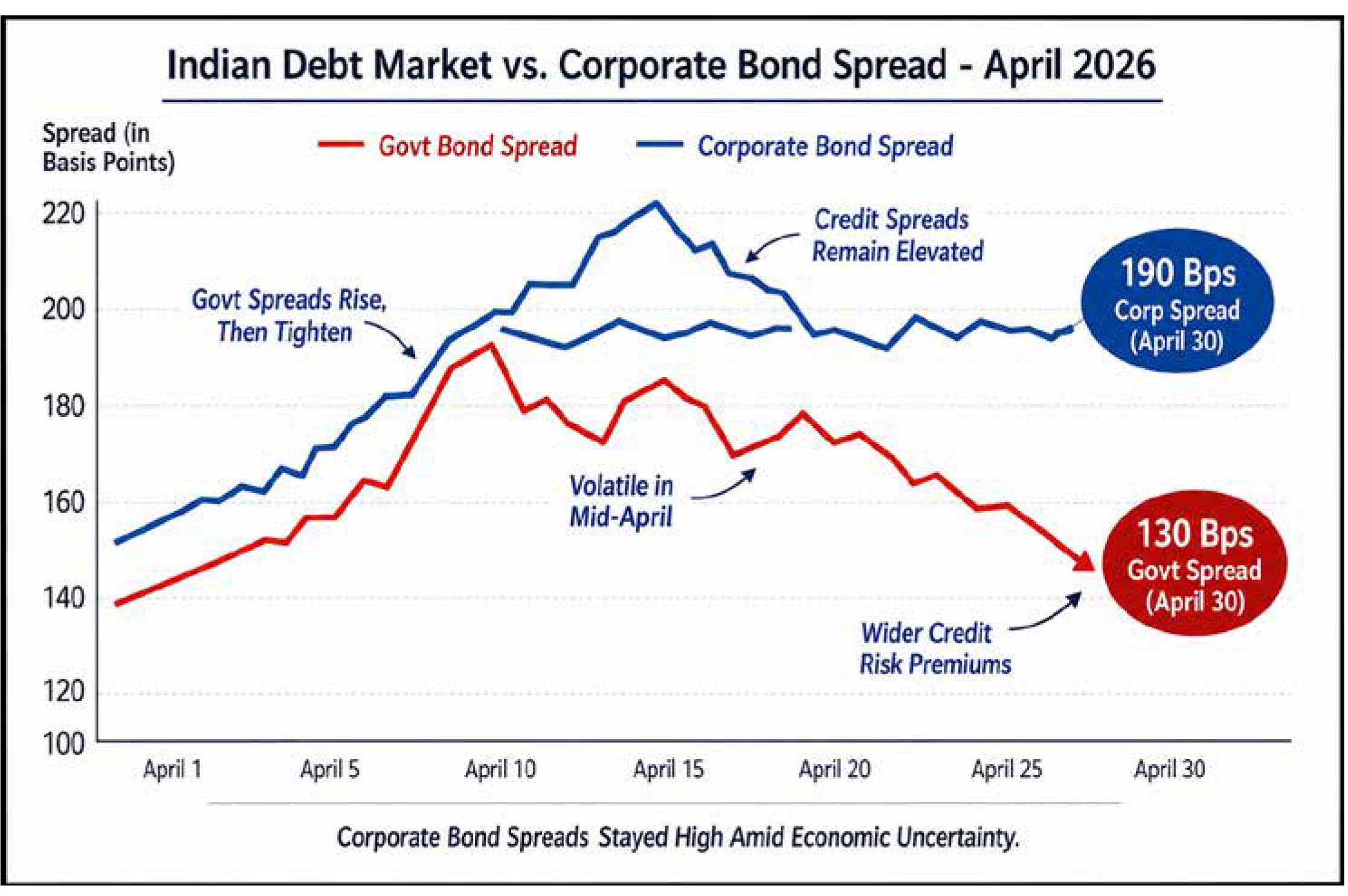
tracked changes in government bond yields but were
further influenced by credit risk considerations.
Top-rated AAA and A1 issuers saw yields rise by around
20–30 basis points, while BBB-rated and lower-quality
issuers experienced more substantial increases of
40–60 basis points or more. Sectoral differences were
also evident. Industries heavily dependent on crude oil or
global trade—such as aviation, shipping, refining, and
certain manufacturing segments—saw sharper yield
increases due to concerns about margin compression
and earnings volatility. Conversely , defensive sectors
like large public sector enterprises, regulated utilities,
and select financial institutions experienced more
moderate yield movements, supported by stable cash
flows and, in some cases, implicit government backing.
In essence, April 2026 underscored the vulnerability of
debt markets to external shocks and the critical
importance of duration management. While rising yields
created near-term pain through capital losses, they also
reset the yield environment to more attractive levels for
future investors, particularly in shorter-duration and
high-quality segments.